

Tokenization promises to make financial assets more accessible, programmable, and liquid. But there’s a peculiar problem emerging as more companies bring traditional equities onchain.
We aren’t creating one tokenized version of Nvidia. We’re creating many.
Different issuers, different blockchains, different custody arrangements, different liquidity pools. All representing exposure to essentially the same underlying stock.
What if we could bring those fragmented representations together?
What if a single token could represent a diversified basket of issuer-specific stock tokens, with an automated market maker continuously facilitating exchanges between them?
And could the mathematics of spherical AMMs help make that possible?
We’re exploring whether multiasset liquidity pools could become a foundation for something bigger: a unified economic representation of tokenized equities.
🎧 A little insight into how our brains work
What do you listen to while running along the beach when you're obsessed with finance, DeFi, and mathematics?
Not music. Not podcasts.
Just an ongoing conversation with ChatGPT about multidimensional liquidity surfaces, spherical AMMs, and whether they could solve one of tokenized equities' most interesting problems.
We're building Folio, not an AMM research lab. Our working hours are focused on getting the product into users' hands. But our idea of relaxing is exploring the mathematics of decentralized finance.
1. One Stock, Many Tokens
Consider Nvidia.
Today, several companies are developing tokenized representations of publicly traded equities. Platforms such as xStocks, Ondo Global Markets, and Robinhood have introduced different approaches to bringing stock exposure onchain.
Each operates within its own technical, legal, and economic framework.
One issuer might hold underlying securities through a custodian. Another might issue a tokenized security with different redemption rights. A third might provide an instrument that tracks the economic performance of the stock without granting direct ownership.
Even when these products reference the same Nvidia shares, they aren’t necessarily interchangeable.
And from a liquidity perspective, that’s a problem.
Instead of concentrating liquidity around one universally recognized representation of Nvidia, we fragment it across issuers, blockchains, and trading venues.
For users, this introduces unnecessary complexity. For market makers, it divides capital across separate markets. For brokers building onchain investment products, it creates additional custody, execution, and operational overhead.
At Folio, we’ve been thinking about this problem from the perspective of building a brokerage that abstracts away blockchain complexity.
A user shouldn’t need to know which tokenization provider supplied their Nvidia exposure, or which blockchain that representation happens to live on, simply to understand their portfolio.
Ideally, they should just see Nvidia.
But hiding that complexity in the interface isn’t the same as solving it underneath.
Could we create an economic abstraction that unifies these representations while preserving transparency about the assets backing them?
 One underlying equity, multiple issuer-specific representations. Could a common liquidity and ownership layer bring them together?
2. Enter the Spherical AMM
Traditional automated market makers typically create liquidity between pairs of assets.
If you wanted to exchange three different tokenized versions of Nvidia, you might create separate pools:
- xNVDA / bNVDA
- xNVDA / rNVDA
- bNVDA / rNVDA
Add more issuers and the number of potential pairwise markets grows rapidly.
For n assets, the number of possible trading pairs is:
With five representations of the same stock, that’s ten potential pairs. With ten representations, it’s forty-five.
Not every pair needs its own pool, of course. Routing through a common asset is an alternative. But pairwise liquidity fragmentation illustrates why multiasset market makers are interesting.
In 2025, Paradigm introduced Orbital, a spherical automated market maker designed for efficient trading between multiple assets expected to maintain approximately equal value.
Note
This discussion was inspired by Paradigm’s research paper, Orbital.
Rather than constructing a separate pool for every trading pair, Orbital uses a multidimensional invariant.
Conceptually, imagine three assets represented as coordinates in three-dimensional space.
Their reserves are constrained by a spherical surface.
Trading one asset for another moves the pool’s reserve position along that surface.
In higher dimensions, the same concept can extend to larger baskets of assets.
Orbital also introduces concentrated-liquidity mechanisms that allow capital to be deployed efficiently around the region where assets are expected to trade near parity.
The mathematics is fascinating, particularly because the system is designed to consolidate liquidity positions efficiently despite operating across multiple assets.
But here’s what caught our attention.
What if those assets weren’t different stablecoins? What if they were different tokenized representations of the same stock?
Instead of USDC, USDT, and DAI, imagine:
- Nvidia represented by xStocks
- Nvidia represented by Robinhood
- Nvidia represented by another eligible issuer
All attempting to track the economic performance of one underlying equity.
The pool wouldn’t primarily be discovering Nvidia’s market price. Traditional equity markets already provide that reference.
Instead, it would facilitate price discovery and exchange between different claims referencing Nvidia.
That distinction is important.
We’re not proposing that an AMM replace equity price discovery.
We’re asking whether a multiasset AMM could efficiently unify liquidity among different tokenized representations of the same underlying asset.
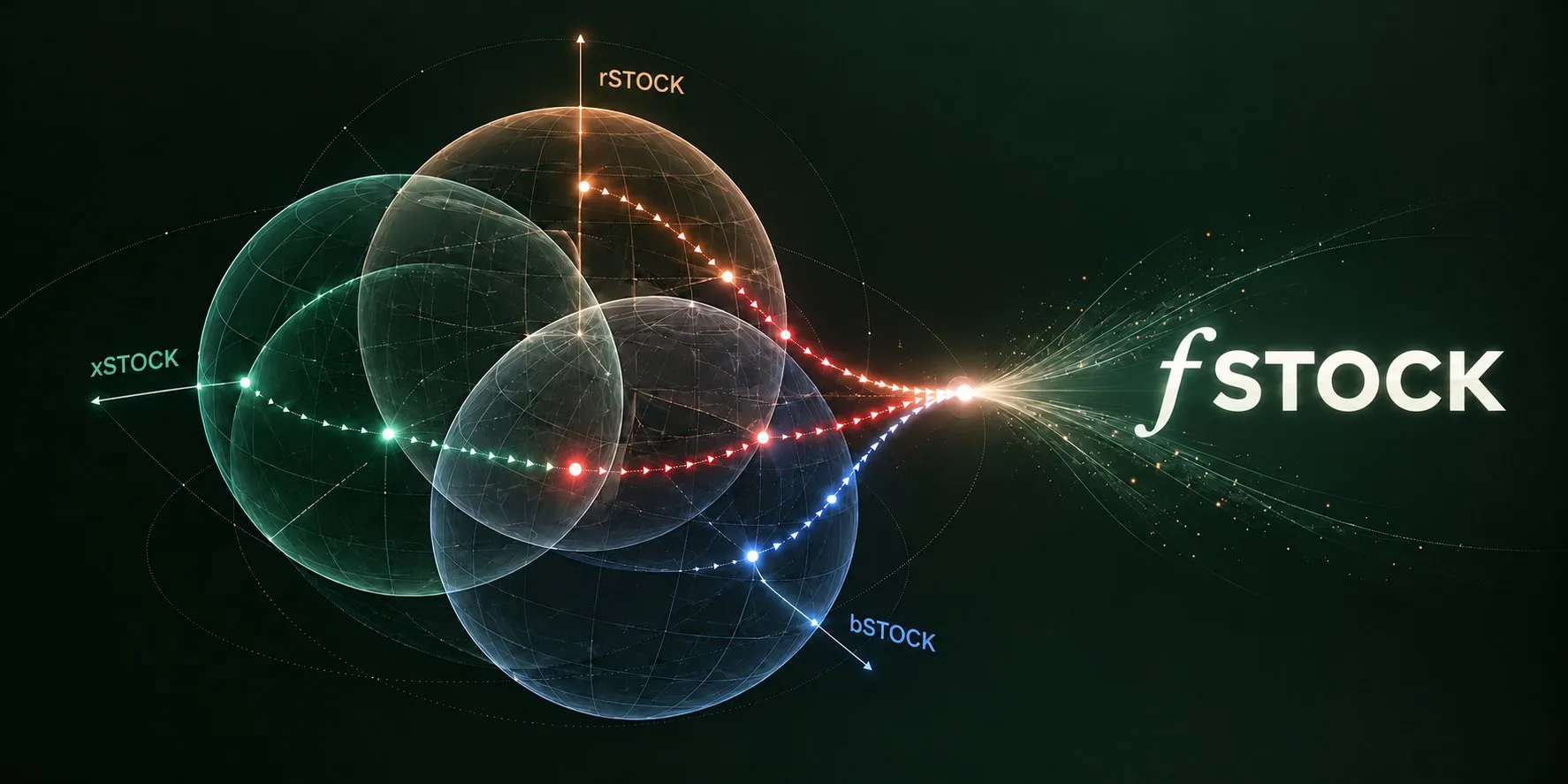 Conceptual exploration of multiasset liquidity surfaces. The illustration is not a mathematically exact representation of the proposed invariant.
Of course, a sphere isn’t necessarily the optimal geometry.
Weighted invariants, asymmetric liquidity surfaces, and issuer-specific concentration parameters may prove more appropriate.
But Orbital provides an intriguing starting point.
3. What If the Pool Share Became the Stock?
Here’s where the idea gets more interesting.
Imagine a multiasset pool containing several issuer-specific representations of Nvidia.
Now imagine that instead of exposing those underlying assets individually, the system issues a single token representing a proportional claim on the pool.
Call it fNVDA.
The italicized f represents a unified share: one token backed by a basket of issuer-specific Nvidia representations.
This is a hypothetical research construct, not an existing Folio product or an announced token.
Suppose our illustrative basket contains:
| Underlying representation | Allocation |
|---|---|
| xStocks NVDA | 40% |
| Ondo NVDA | 35% |
| Another eligible issuer | 25% |
A user holds fNVDA rather than three separate tokens.
From the user’s perspective, there’s one asset.
Underneath, the system maintains exposure to multiple tokenization providers.
This could offer several interesting properties.
Simpler portfolio accounting. Instead of maintaining separate positions and token accounts for every issuer, an application could expose one representation.
Issuer diversification. Rather than depending entirely on one provider, the backing could be distributed across several independently operated issuers.
Unified liquidity. A multiasset pool could potentially allow exchanges among issuer representations without requiring separate liquidity for every possible pair.
A potential revenue mechanism. Trading fees could compensate liquidity providers or support the system’s operations, depending on how the economics are structured.
There’s also a subtle architectural question.
Should fNVDA literally be a share of the AMM itself?
Or should it represent a separately managed basket vault, with an AMM providing liquidity and rebalancing services underneath?
An AMM share has an appealing simplicity: the pool already holds the underlying assets, and the LP token already represents a claim on those reserves.
One possibility worth exploring is distributing trading fees by minting additional pool shares to a treasury, rather than allowing all fee revenue to accumulate in existing shares.
That could help separate trading-fee revenue from the intended value of the unified token.
But it doesn’t eliminate the economic risks of market making.
The pool’s inventory can change. Arbitrageurs can extract value. Issuer-specific tokens can diverge from their reference prices.
A separately managed vault might offer more control over portfolio composition, while a combined AMM-and-vault architecture might offer greater simplicity.
We don’t yet know which is preferable.
And there’s a deeper question: should one fNVDA always represent exactly one normalized Nvidia share-equivalent, or should it represent a proportional claim on a basket whose value may fluctuate relative to Nvidia?
Those are fundamentally different financial instruments.
4. The Catch: Not All Nvidia Tokens Are Equal
This is where our thought experiment encounters its biggest problem.
Two tokens tracking Nvidia are not necessarily equally safe.
They may have different custodians, redemption arrangements, legal structures, liquidity conditions, and counterparty risks.
Suppose three issuer-specific tokens all trade at approximately the same price.
Our spherical AMM facilitates exchanges among them.
Then one issuer experiences a serious problem.
Perhaps redemptions are suspended. Perhaps its custodian becomes insolvent. Perhaps the market simply loses confidence in that issuer’s ability to honor its obligations.
Its token begins trading at a discount.
Arbitrageurs can purchase the discounted token elsewhere and sell it into our pool in exchange for higher-quality Nvidia representations.
The pool accumulates more of the impaired token while surrendering healthier assets.
Our supposedly diversified basket could gradually become concentrated in the weakest issuer.
This is the same fundamental adverse-selection problem that affects stablecoin AMMs during depegs.
And it’s why an elegant liquidity invariant is not, by itself, a complete risk-management system.
Could the geometry itself help manage the risk?
This is where we think the research becomes particularly interesting.
What if the liquidity surface were weighted to reflect different issuer preferences?
What if an LP could specify a maximum inventory for each underlying token?
For example, an issuer’s token might normally represent 15% of a basket, but the pool could refuse to accumulate more than a predefined maximum number of units.
What if trading fees increased dynamically as the pool became increasingly overweight a particular issuer?
And what if those fees were directional, making trades that increase risky exposure more expensive while keeping trades that reduce that exposure inexpensive?
These mechanisms wouldn’t eliminate issuer risk.
They would change how much risk the pool could accumulate, how quickly it accumulated it, and how much compensation LPs received for accepting it.
There are difficult tradeoffs.
A strict inventory ceiling limits losses from additional accumulation, but also limits how much liquidity the pool can provide during a one-sided selloff.
Higher fees can compensate LPs for toxic order flow, but may also reduce trading efficiency and create new arbitrage dynamics.
A weighted invariant may express preferred issuer exposure, but weighting alone does not guarantee that the pool remains diversified during market stress.
The real research question is whether we can preserve the capital efficiency of multiasset concentrated liquidity while giving LPs meaningful control over issuer-specific risk.
We think that question deserves deeper mathematical modeling and simulation.
5. Beyond One Blockchain
There’s another dimension to this fragmentation problem.
Tokenized equities don’t all live on the same blockchain.
Some representations are issued on Solana. Others operate on Ethereum or other networks. Still others may exist within brokerage or custody systems that aren’t directly interoperable with public blockchains.
A unified economic representation could potentially abstract away some of those boundaries.
Imagine fNVDA existing on multiple supported chains while its underlying collateral remains distributed across issuer-specific vaults.
Moving fNVDA between chains wouldn’t necessarily require moving the underlying stock representations every time.
Instead, ownership claims could move independently, with collateral accounting and rebalancing handled through a separate settlement process.
This might create opportunities for periodic rather than just-in-time cross-chain rebalancing.
It wouldn’t eliminate bridging risks, settlement requirements, or the need for robust collateral accounting.
Nor would it automatically make restricted or nontransferable issuer assets available across chains.
But it suggests an interesting separation between where an asset is held and where its economic representation can be used.
For a global brokerage, that separation could be valuable.
We intend to explore this idea further, but the cross-chain architecture deserves its own research rather than a rushed solution here.
An Open Research Agenda
Open questions
What began as a conversation about spherical AMMs has opened up a surprisingly broad set of questions.
- Can multiasset AMMs consolidate liquidity across tokenized representations of the same equity?
- Can weighted liquidity surfaces reflect differences in issuer quality and risk?
- Can inventory ceilings, dynamic fees, and other risk controls prevent a deteriorating issuer from consuming a pool’s healthy collateral?
- Could an AMM share itself become a reliable unified equity representation, or would a separate basket vault provide better guarantees?
- And can these ideas extend across blockchains without requiring every transaction to trigger an immediate movement of underlying collateral?
These are not questions we’re claiming to have solved.
They’re questions we think are worth investigating.
Over the coming weeks, we’d like to explore some of them through mathematical modeling, simulations, and small experimental implementations.
One particularly useful experiment would compare a conventional multiasset AMM, a weighted spherical invariant, and a risk-managed version with inventory ceilings and directional fees.
We could simulate an issuer-specific impairment and measure how each design behaves: the inventory it accumulates, the losses it experiences, the liquidity it preserves, and the arbitrage opportunities it creates.
We may discover that spherical AMMs aren’t the right answer.
A traditional basket vault, direct issuer conversions, or a hybrid execution architecture might ultimately prove more practical.
That’s part of the point of doing the research.
Tokenization is giving us new ways to represent financial assets. But as the number of issuers and networks grows, we also need better ways to make those representations economically useful together.
The goal isn’t to pretend that every token referencing the same stock is identical. It’s to explore whether we can unify liquidity and ownership while preserving the distinctions that actually matter.
One stock. Many issuers. Perhaps, eventually, one coherent market.
This article is an exploratory research discussion from the Folio team. The proposed unified tokens, AMM designs, and risk-management mechanisms are hypothetical and do not represent announced Folio products or investment guarantees.